Introduction to Mechanical Systems Design
Mechanical engineering is one of the broadest and oldest engineering disciplines, forming the foundation of modern industry. Mechanical systems design encompasses the creation of machines, devices, and systems that convert energy into useful work. From micro-electromechanical systems to massive power plants, mechanical engineers design the moving world around us.

1. Statics: The Foundation of Equilibrium
Statics is the study of forces on stationary bodies — the foundation of structural analysis and machine design.
- Newton's Laws: First law (inertia), second law (F = ma), third law (action-reaction)
- Free Body Diagrams: Visual representation of all forces acting on a body
- Equilibrium Equations: ΣF_x = 0, ΣF_y = 0, ΣM = 0
- Trusses: Structures composed of two-force members (bridges, roofs, towers)
2. Dynamics: Motion and Forces
Dynamics extends statics to bodies in motion — essential for designing moving machinery, vehicles, and robots.
- Kinematics: Study of motion without considering forces
- Kinetics: Study of motion considering forces that cause it
- Rectilinear Motion: Motion along a straight line
- Curvilinear Motion: Motion along a curved path
- Rotational Motion: Angular displacement, velocity, acceleration

# Kinematic Equations for Constant Acceleration
v = u + a * t
s = u * t + 0.5 * a * t²
v² = u² + 2 * a * s
# Car accelerating 0 to 60 mph (26.8 m/s) in 5 seconds
a = 26.8 / 5 = 5.36 m/s²
distance = 0.5 * 5.36 * 25 = 67 meters
3. Thermodynamics: Energy and Heat Transfer
Thermodynamics deals with energy conversion — how heat transforms into work and vice versa.
- Zeroth Law: Temperature concept
- First Law: Energy conserved (ΔU = Q - W)
- Second Law: Entropy increases; heat cannot spontaneously flow cold to hot
- Third Law: As temperature approaches absolute zero, entropy approaches zero
| Thermodynamic Cycle | Application | Efficiency |
|---|---|---|
| Otto Cycle | Gasoline Engines | 25-35% |
| Diesel Cycle | Diesel Engines | 35-45% |
| Brayton Cycle | Gas Turbines | 30-40% |
| Rankine Cycle | Steam Power Plants | 30-42% |
4. Fluid Mechanics: The Science of Flow
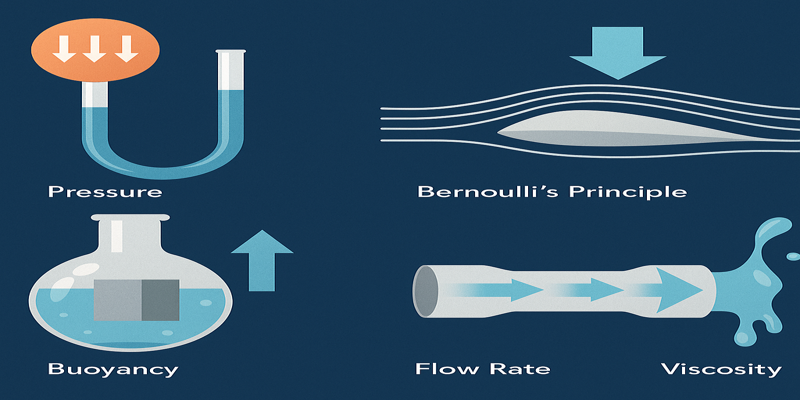
Fluid mechanics studies liquids and gases in motion and at rest — essential for pumps, turbines, piping, and aerodynamics.
- Hydrostatics: Fluids at rest, pressure distribution
- Bernoulli's Equation: Conservation of energy in flowing fluids
- Laminar vs Turbulent Flow: Reynolds number determines flow regime
- Viscosity: Fluid's resistance to flow
- Boundary Layer: Region near surfaces where viscous effects dominate
# Bernoulli's Equation
P + 0.5 * ρ * v² + ρ * g * h = constant

# Reynolds Number
Re = (ρ * v * D) / μ
# Re < 2000: Laminar | Re > 4000: Turbulent
5. Machine Design: Creating Components
Machine design applies mechanics, materials science, and manufacturing principles to create mechanical components that function reliably.
- Stress and Strain: σ = F/A, ε = ΔL/L
- Factor of Safety: FoS = Ultimate Stress / Allowable Stress
- Fatigue: Failure under cyclic loading
- Materials Selection: Steel, aluminum, composites, polymers
- Failure Theories: Maximum distortion energy (von Mises), maximum shear stress
# Stress Calculations
σ = F / A
τ = T * r / J (torsion)
σ_b = M * c / I (bending)

# Factor of Safety
FoS = σ_yield / σ_allowable
Typical FoS: 2-3 for general machinery, 4-8 for critical components
6. CAD and Computer-Aided Engineering
Modern mechanical design relies on digital tools for modeling, simulation, and manufacturing preparation.
- CAD (Computer-Aided Design): SolidWorks, CATIA, AutoCAD, Fusion 360
- FEA (Finite Element Analysis): ANSYS, Abaqus for stress, thermal, vibration analysis
- CFD (Computational Fluid Dynamics): Fluent, OpenFOAM for flow simulation
- CAM (Computer-Aided Manufacturing): CNC programming, toolpath generation
- PLM (Product Lifecycle Management): Managing design data and revisions

7. Manufacturing Processes
Understanding how parts are made is essential for effective mechanical design.
- Casting: Sand casting, investment casting, die casting
- Forming: Forging, rolling, extrusion, stamping
- Machining: Turning, milling, drilling, grinding
- Additive Manufacturing: 3D printing, selective laser sintering
- Joining: Welding, brazing, adhesives, fasteners
| Process | Tolerance | Surface Finish | Cost (Relative) |
|---|---|---|---|
| Sand Casting | ±0.5mm | Rough | Low |
| CNC Machining | ±0.01mm | Excellent | High |
| 3D Printing | ±0.1mm | Fair | Medium |
| Injection Molding | ±0.05mm | Excellent | Very High (tooling) |
8. Mechanical Engineering Applications
Mechanical engineers work across diverse industries solving real-world problems.
- Automotive: Engines, transmissions, chassis, suspension, electric vehicles
- Aerospace: Aircraft structures, propulsion, landing gear, flight controls
- Energy: Wind turbines, gas turbines, nuclear reactors, solar tracking
- Robotics: Manipulators, actuators, end effectors, mobile robots
- Biomedical: Prosthetics, surgical instruments, medical devices, implants
- HVAC: Heating, ventilation, air conditioning systems
9. Mechanical Engineering Career Path
| Role | Experience | Salary Range | Key Skills |
|---|---|---|---|
| Junior Mechanical Engineer | 0-2 years | $60-75k | CAD, GD&T, fundamentals |
| Mechanical Designer | 2-5 years | $70-90k | SolidWorks, manufacturing |
| Project Engineer | 5-8 years | $85-110k | Project management, leadership |
| Senior Mechanical Engineer | 8-12 years | $100-130k | FEA, CFD, system design |
| Engineering Manager | 10+ years | $120-160k | Strategy, team management |
| Principal/Technical Fellow | 15+ years | $140-200k+ | Technical authority, innovation |
10. Essential Tools and Software
- CAD: SolidWorks, CATIA, AutoCAD, Fusion 360, Creo
- FEA/CFD: ANSYS, Abaqus, COMSOL, OpenFOAM
- Programming: MATLAB, Python, C++ for analysis and automation
- Project Management: Jira, Asana, MS Project
- Version Control: Git, SVN for design data
11. Professional Certifications
- Professional Engineer (PE): Licensure for independent practice
- Certified SolidWorks Professional (CSWP): CAD proficiency
- Certified Manufacturing Engineer (CMfgE): Manufacturing expertise
- Six Sigma Green/Black Belt: Quality and process improvement
- Project Management Professional (PMP): Project leadership