⚡ What is Project Management?
Project management applies knowledge, skills, tools, and techniques to meet project requirements. It balances scope, time, cost, quality, resources, and risk. The global project management market is projected to reach $12.7 trillion by 2030, with 25 million new project professionals needed annually.
🔄 The Agile Manifesto & Principles
Agile emerged in 2001 when 17 software developers created the Agile Manifesto, valuing: Individuals and interactions over processes and tools; Working software over comprehensive documentation; Customer collaboration over contract negotiation; Responding to change over following a plan.
12 Agile Principles
- 1. Customer satisfaction through early and continuous delivery
- 2. Welcome changing requirements, even late in development
- 3. Deliver working software frequently (weeks rather than months)
- 4. Business people and developers work together daily
- 5. Build projects around motivated individuals, trust them
- 6. Face-to-face conversation is most efficient
- 7. Working software is the primary measure of progress
- 8. Sustainable development, constant pace indefinitely
- 9. Continuous attention to technical excellence enhances agility
- 10. Simplicity — maximizing work not done — is essential
- 11. Self-organizing teams produce best architectures
- 12. Regular reflection on how to become more effective, adjust
📋 Scrum Framework
Scrum is the most widely used Agile framework. It structures work into fixed-length iterations called sprints (typically 2-4 weeks).
Scrum Roles
- Product Owner: Defines features, prioritizes backlog, represents stakeholders. Single point of accountability for product value.
- Scrum Master: Facilitates process, removes impediments, coaches team. Servant leader who protects the team.
- Development Team: Cross-functional group delivering increments. Self-organizing, typically 3-9 members.
Scrum Events
- Sprint Planning: Team selects backlog items, defines sprint goal (2-4 hours for 2-week sprint)
- Daily Scrum: 15-minute daily sync: What did I do yesterday? What will I do today? Any blockers?
- Sprint Review: Demo completed work to stakeholders, gather feedback (1-2 hours)
- Sprint Retrospective: Team reflects on what went well, what to improve (1-2 hours)
# Sprint Structure (2-week)
Day 1: Sprint Planning (2-4 hours)
Days 2-12: Development (Daily Scrum 15 min)
Day 13: Sprint Review (1-2 hours)
Day 14: Sprint Retrospective (1-2 hours)

📊 Kanban Method
Kanban visualizes workflow, limits work-in-progress (WIP), and optimizes flow. Unlike Scrum, Kanban has no fixed iterations — work flows continuously.
- Visualize Workflow: Use a board with columns (To Do, In Progress, Review, Done)
- Limit Work in Progress (WIP): Set maximum items per column. WIP limits reveal bottlenecks and improve flow.
- Manage Flow: Monitor cycle time, lead time, throughput. Optimize for faster delivery.
- Make Policies Explicit: Define rules for moving cards between columns.
- Implement Feedback Loops: Regular reviews, metrics, continuous improvement.
💧 Waterfall Methodology
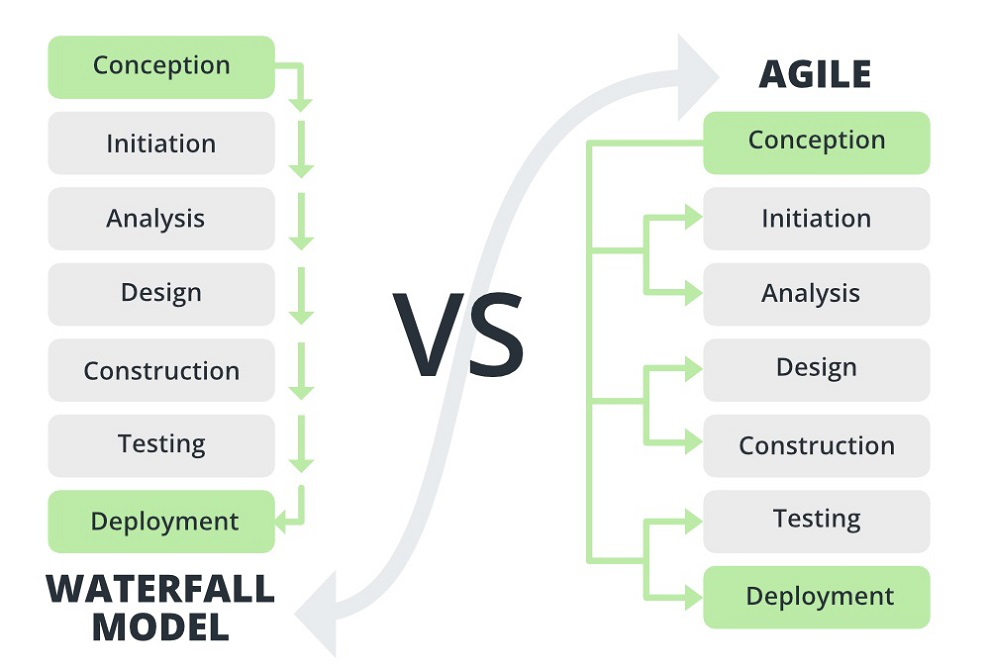
Waterfall is the traditional sequential project management approach where each phase completes before the next begins. Phases: Requirements → Design → Implementation → Testing → Deployment → Maintenance. Best for projects with stable, well-understood requirements, regulatory compliance needs, or when customer involvement is limited.
🎯 PMP Certification & PMBOK
Project Management Professional (PMP) is the most recognized project management certification globally. It validates experience, education, and competency to lead projects. PMP-certified professionals earn 20% more on average and deliver projects with 30% higher success rates.
PMBOK Process Groups
- Initiating: Define project charter, identify stakeholders
- Planning: Scope, schedule, cost, quality, resources, risk, procurement
- Executing: Direct and manage work, manage teams, quality assurance
- Monitoring & Controlling: Track progress, manage changes, validate scope
- Closing: Finalize activities, lessons learned, release resources
10 Knowledge Areas
- Integration, Scope, Schedule, Cost, Quality, Resources, Communications, Risk, Procurement, Stakeholder
# PMP Eligibility
Bachelor's degree: 36 months leading projects + 35 hours education
No degree: 60 months leading projects + 35 hours education
Exam: 180 questions, 230 minutes, covers 5 process groups
🔄 Agile vs Waterfall Comparison
- Approach: Agile = Iterative; Waterfall = Sequential
- Requirements: Agile = Flexible, evolving; Waterfall = Fixed up front
- Customer Involvement: Agile = Continuous throughout; Waterfall = Milestone reviews only
- Testing: Agile = Throughout development; Waterfall = After development phase
- Delivery: Agile = Frequent incremental releases; Waterfall = Single final delivery
- Change Cost: Agile = Low (adaptable); Waterfall = High (difficult to change)
- Best For: Agile = Complex, uncertain, innovation; Waterfall = Simple, stable, regulated
📈 Project Management Tools
- Jira: Agile project tracking, Scrum and Kanban boards, roadmaps, reporting
- Asana: Task management, workflows, team collaboration, portfolio views
- Trello: Simple Kanban boards, visual task management, power-ups
- Microsoft Project: Gantt charts, resource management, enterprise features
- Monday.com: Work operating system, customizable workflows, automation
- ClickUp: All-in-one productivity, docs, goals, chat, whiteboards
🎯 Project Management Certifications
- PMP (PMI): Gold standard, comprehensive project management ($150k avg salary)
- CAPM (PMI): Entry-level, project management fundamentals
- CSM (Scrum Alliance): Certified Scrum Master, Agile focus
- PSM (Scrum.org): Professional Scrum Master, rigorous assessment
- SAFe Agilist: Scaled Agile Framework for enterprise Agile
- Prince2: Process-based method, popular in UK/Europe
- PMI-ACP: Agile Certified Practitioner, multiple Agile methods
🚀 Future of Project Management
- AI in Project Management: Predictive analytics, resource optimization, risk detection, automated reporting
- Hybrid Methodologies: Combining Agile and Waterfall for optimal results in complex environments
- Remote Project Management: Distributed teams, asynchronous communication, digital collaboration tools
- Data-Driven Decisions: Metrics-based management, real-time dashboards, predictive insights
- Soft Skills Emphasis: Emotional intelligence, stakeholder management, conflict resolution
🎓 Project Management Careers
- Project Coordinator: Entry-level, support PMs, documentation ($50-75k)
- Project Manager: Lead projects, manage stakeholders, budgets ($80-120k)
- Senior PM: Complex projects, program management, strategic alignment ($100-150k)
- Program Manager: Manage multiple related projects, cross-functional coordination ($120-170k)
- Portfolio Manager: Strategic alignment, resource allocation, investment decisions ($140-200k)
- PMO Director: Project management office leadership, standards, governance ($150-220k)
- Agile Coach: Organizational transformation, team coaching, Agile adoption ($130-180k)